
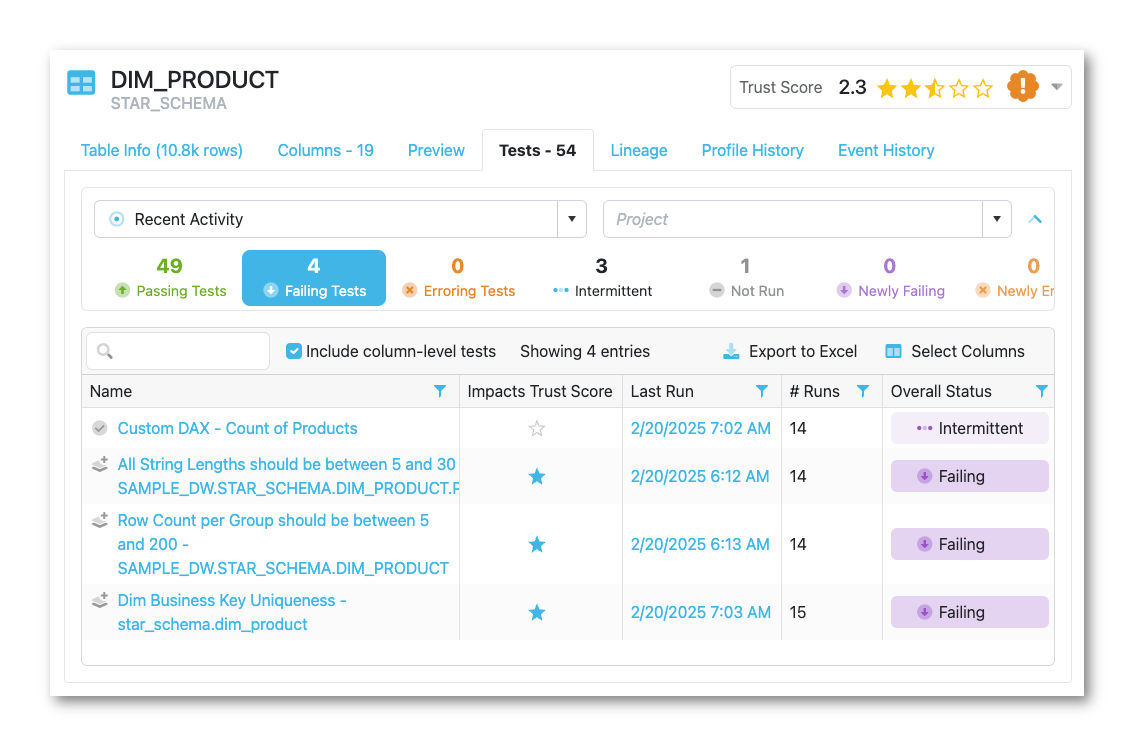
Table test results after a migration wave
Prove the data you moved is the data you had.
Validatar checks your legacy source against your cloud target in four steps: plan how the two sides will be compared, then check that every row is there, that nothing is extra, and that no values changed. Then it keeps checking after cutover.
Table test results after a migration wave
The data usually arrives. What's missing is proof that it arrived intact, and that's what the business is waiting for.
Precision, nulls, and time zones shift between platforms in ways a count never shows.
Testing gets squeezed into the final weeks, right when there's no time left to fix what it finds.
Transformations rebuilt for the new platform produce results that are nearly right, which is hard to spot.
When someone finds a bug and can't see what was tested or how, confidence in the whole migration drops.
Four questions, asked in order. Each one has to pass before the next one means anything.
For engineers
Some teams have the people to run validation themselves. Others need it done for them. Validatar works either way.
Do it yourself
You have a QA or data team. Validatar gives them the comparisons, the scheduling, and the evidence trail.
Done for you
Short on people or time? Our team scopes, builds, and runs the validation, then hands you the evidence to sign off.
Start with a free Mini Validation. We connect to your data, show you what we'd compare, and scope the work, whichever path you choose.
Book a Free Mini Validation →We connect to your source and target, inside your security rules.
We compare up to 10 tables, 10 pipeline outputs or 5 reports, so you see real differences, not a slide.
Within 10 business days of connecting, you get a scope for running it yourself, or a fixed price for having us run it.
Short answers to what migration leads ask first.
Work in four steps: plan how the two sides will be compared, then check that every row is there, that nothing is extra, and that no values changed. Then keep the cheapest checks running after every load so drift is caught early.
Warehouses and databases such as Teradata, Oracle, SQL Server, Netezza, Db2, and Hadoop. ETL and ELT jobs from SSIS, Informatica, DataStage, and Talend rebuilt in dbt, Coalesce, Databricks, or Snowflake. BI reports in Tableau, Power BI, Cognos, BusinessObjects, MicroStrategy, Qlik, and SSRS. On Snowflake and Databricks, comparisons run inside your own account and only the summary result comes back to Validatar. Other platforms connect too.
Load timestamps, batch IDs, and file names differ by design. Mark them once to be ignored, so they don't bury the differences that matter.
Yes. A Validatar Data Agent runs inside your network to reach databases that can't be exposed, or you can run Validatar Server on your own infrastructure.
Yes. Many teams run Validatar themselves. If you're short on people or time, our team can run it for you through the Migration Validation Program.
Our done-for-you service. Our team scopes, builds, and runs the validation for a fixed price, set after a free Mini Validation, and hands your data owners a Sign-off Evidence Pack.
Pick 10 tables, 10 pipeline outputs, or 5 reports. We connect to both sides and compare them, and within 10 business days of connecting you see real differences, plus a scope for running it yourself or a fixed price for having us run it.
One Validatar customer tested 2,300 tables in a single week.
They become scheduled regression tests on the new platform, with a full execution history for audits.
The checklist covers what to compare, in what order, and what evidence to keep for sign-off.