
Trust scores in the Validatar catalog
Show people what to trust before they use it.
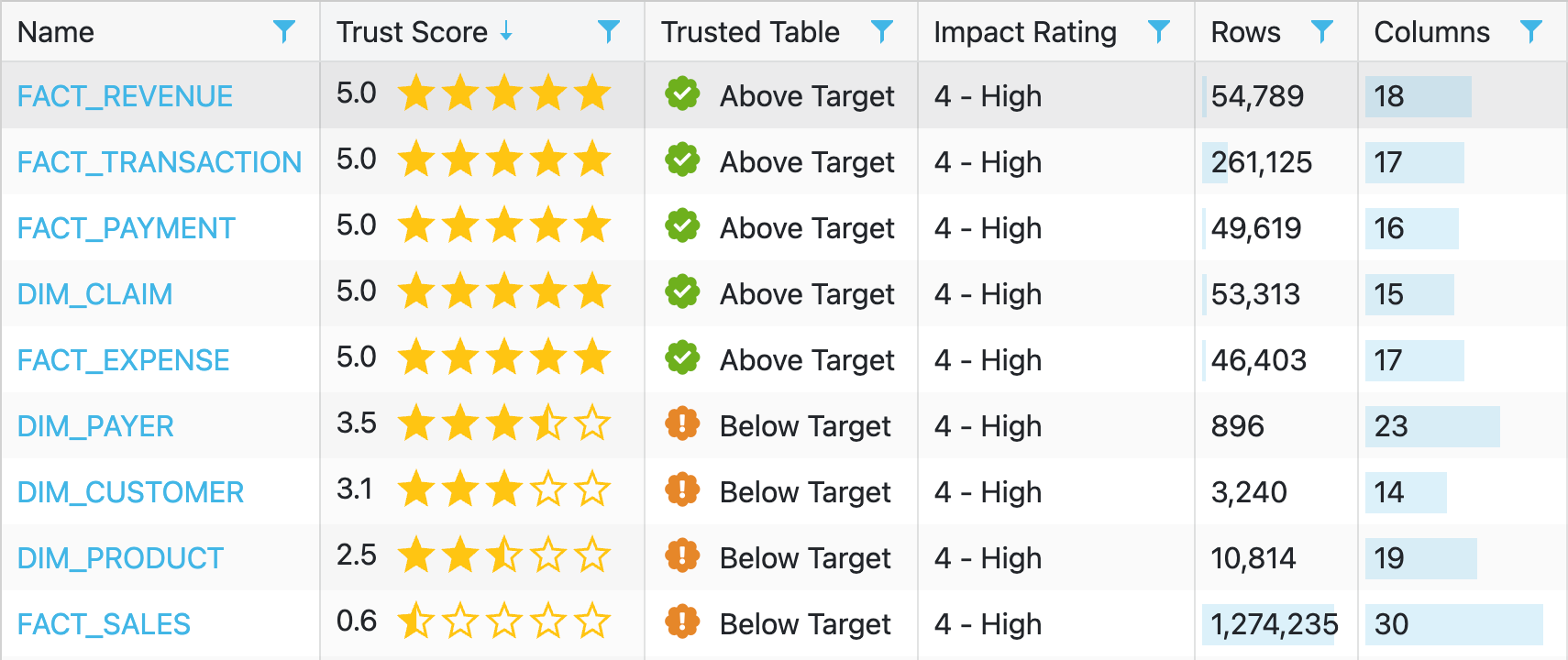
Validatar gives every table a trust score from 0 to 5 stars, based on how its tests pass and how much of its quality they cover. It publishes those scores into catalogs like Alation, Atlan, and Collibra, where analysts, stewards, and AI tools look for data.
Trust scores in the Validatar catalog
A catalog can tell people what data means and who owns it. Without test results, it can't tell them whether the data is right.
Without quality evidence
Analysts ask in Slack whether a table is safe to use
Stewards own data they have no way to measure
AI tools use whatever data they can reach
Audits ask for proof that lives in spreadsheets
With Validatar
A trust score sits on the table, right in the catalog
Each table has a target set by how much it matters
AI work on your tests and metadata is logged and reversible
Every test run is kept, so the proof is always current
Two measures over a recent window of test runs, multiplied into one score anyone can read.
How well the table's tests pass, weighted by how severe each test is.
How many quality dimensions those tests cover.
0 to 5 stars, compared with a target set by the table's impact rating.
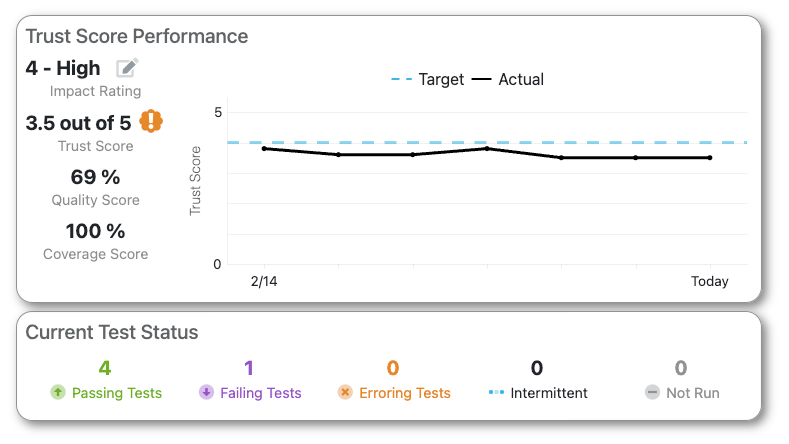
Each table's score is recorded daily, so you can see when it dipped below target and which tests are failing right now.
Your catalog already holds owners, terms, and lineage. Validatar adds the proof, while leveraging all of the context provided by the catalog.
Trust, quality, and coverage scores on each table, with results by quality dimension and a link back to every test.
Owners, stewards, business terms, classifications, and lineage, so failures reach the right steward.
Integrations
AI raises the stakes on data quality in two ways: the data AI uses, and the work AI does.
Trust scores show which tables are fit to feed a model or an AI assistant, before anyone points one at them.
When an AI assistant works in Validatar, each change it makes is recorded as an AI Action that can be reviewed and reverted.
ISO/IEC 42001 for responsible AI management, plus SOC 2 Type II and HIPAA compliance for Validatar Cloud.
Short answers to what governance teams ask first.
A rating from 0 to 5 stars that tells you how far to trust a table. Validatar multiplies a quality score, how well the table's tests pass weighted by severity, by a coverage score, how many quality dimensions the tests cover.
Alation, Atlan, and Collibra, plus Validatar's own catalog. Scores flow into the catalog, and owners, stewards, terms, and lineage flow back into Validatar.
Stored trust scores are calculated once a day over a look-back window, 14 days by default. Live quality scores in projects and the catalog show recent results as they happen.
Yes. Each table's impact rating sets its target trust score, so the tables that matter most are held to a higher bar.
AI tools connect through Validatar's MCP server and act as a named user with that user's permissions. Every change they make is logged as an AI Action that can be reviewed and reverted.
Walk through trust scores and your catalog integration with our team.